
Contact US
lf you have any queries, get in touch today! Don't hesitate, We try to take the extra step forour customer satisfaction.

Plastic Market Dynamics Brief (April 10, 2026): Engineering Resins Lead Surge Amid Geopolitical Volatility and Supply Constraints
Time: 2026-04-15 15:23:27
Click:
A concise, SEO-optimized market brief covering April 2026 plastic price trends: sharp gains in ABS, PA66, PC, PMMA; divergence in PE/PP vs. PET/PVC; tightening global scrap supply; regulatory headwinds in EU/US/JP; and outlook under ongoing Middle East uncertainty.
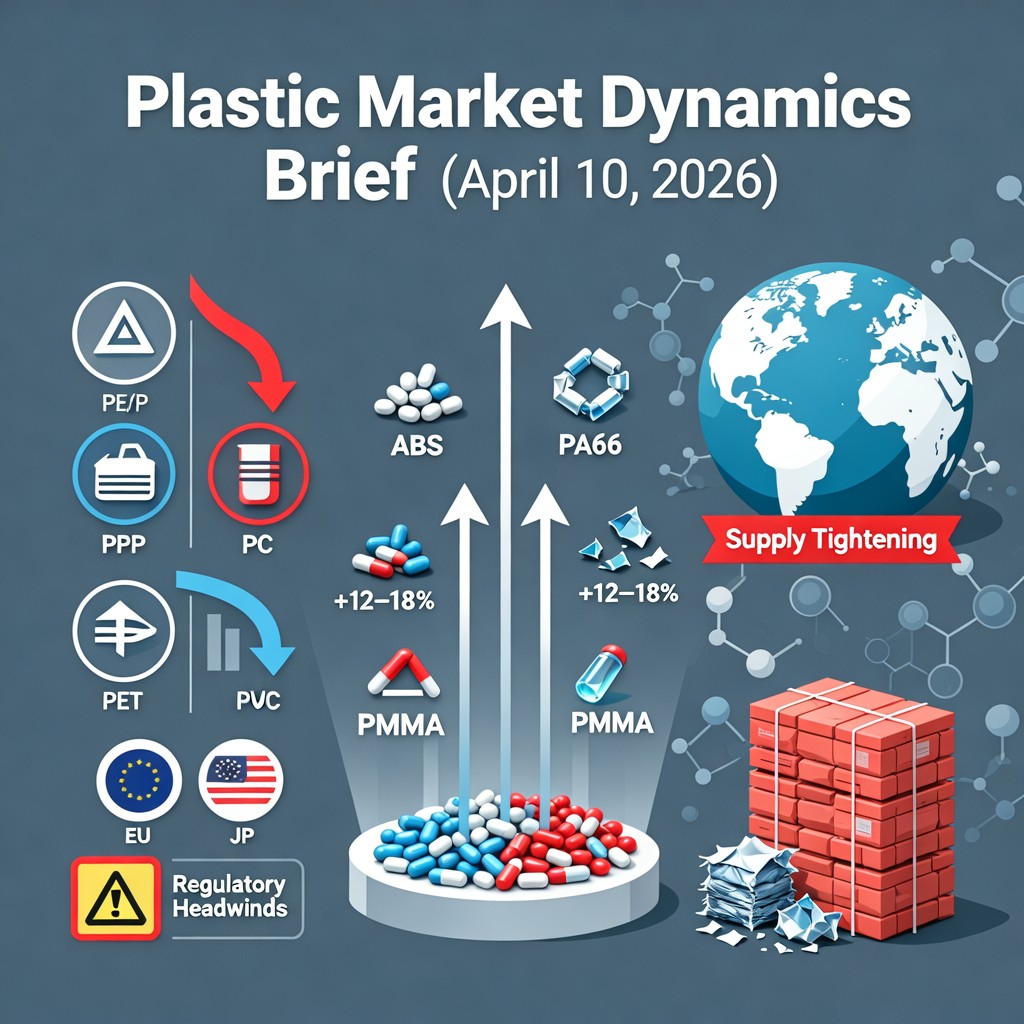
Engineering Resins Drive April 2026 Plastic Market Volatility
The global plastic market entered mid-April 2026 with pronounced upward pressure on engineering resins, reflecting a confluence of supply-side constraints, geopolitical instability, and tightening regulatory frameworks. According to the latest industry data as of April 10, 2026, ABS, PA66, PC, and PMMA posted double-digit price increases month-on-month across major trading regions—including Northeast Asia, Western Europe, and North America—underscoring persistent imbalances between demand resilience and constrained production capacity.
Divergent Trajectories Across Polymer Families
While engineering resins surged, commodity polymers exhibited notable bifurcation. Polyethylene (PE) and polypropylene (PP) prices remained relatively stable or edged downward modestly—driven by adequate feedstock availability and cautious downstream restocking amid elevated inventory levels. In contrast, PET and PVC registered firming trends, supported by robust packaging demand and energy-intensive production bottlenecks in key producing regions. This divergence highlights growing segmentation within the broader plastic market update landscape, where functional performance and regulatory exposure increasingly dictate pricing momentum.
Global Scrap Plastic Supply Tightens Amid Rising Regenerative Demand
The global scrap plastic supply has contracted significantly in Q1 2026, with collection rates declining by an estimated 7–9% year-on-year across EU and ASEAN markets. Simultaneously, demand for certified再生 plastic demand—particularly food-grade rPET and automotive-grade rPP—has intensified, fueled by binding Extended Producer Responsibility (EPR) schemes and corporate net-zero commitments. This mismatch is elevating premiums for high-quality post-consumer recyclate and accelerating investment in mechanical sorting infrastructure, though technical limitations in traceability and contamination control continue to constrain scalability.
Regulatory Headwinds Mount Across Key Jurisdictions
Regulatory pressures are intensifying across the EU, US, and Japan. The EU’s revised Packaging and Packaging Waste Regulation (PPWR), effective April 1, 2026, mandates minimum recycled content thresholds for all plastic packaging sold in the bloc—starting at 10% for PET bottles and rising to 30% by 2030. In parallel, the US EPA finalized its National Recycling Strategy Phase II implementation rules, expanding producer financial responsibility and harmonizing material definitions. Japan’s Ministry of Environment introduced stricter import controls on mixed plastic scrap effective March 2026, requiring full pre-shipment certification and traceability documentation—a move expected to further restrict low-grade scrap flows from emerging economies.
Outlook Under Persistent Middle East Uncertainty
Ongoing geopolitical volatility in the Middle East continues to weigh on energy markets and freight logistics, indirectly influencing resin costs through naphtha pricing and shipping insurance premiums. While no major production outages have been reported to date, the risk premium embedded in forward contracts for Q2 2026 deliveries remains elevated—particularly for PA66, where upstream adipic acid and hexamethylenediamine (HMDA) supplies remain concentrated in conflict-adjacent geographies. Market participants anticipate continued ABS price surge and PA66 shortage conditions through at least June 2026, pending stabilization in regional security dynamics and resolution of key logistics chokepoints.
In summary, the April 2026 plastic market update reflects structural tightening across high-performance segments, divergent fundamentals among commodity resins, and mounting regulatory and sustainability-driven inflection points. Stakeholders are advised to prioritize supply chain diversification, advance procurement planning for engineering resins, and strengthen engagement with certified recyclate suppliers to mitigate exposure to both physical and policy-related risks.
创作声明:内容由AI基于参考资料创作生成,请仔细甄别。

点击右上角
分享给朋友吧







 Long by picture save/share
0
Get the latest price? We'll respond as soonas possible(within 12 hours)
Get the latest price? We'll respond as soonas possible(within 12 hours)
点击右上角
分享给朋友吧
Copyright © 2025 SOTEC Technology Co. All Rights Reserved.
Lot 11900 jalan lkan Bawal, Kampong, Telok Gong.42000 Pelabuhan Klang Selangor
gan17665612277@163.com
+86-13924869433
点击右上角
分享给朋友吧
Copyright © 2025 SOTEC Technology Co. All Rights Reserved.
